
The Whitehat System Is Broken. Here Is What Needs to Change.
On Sunday, May 10th, 2026, an attacker drained Renegade Finance and left a message.
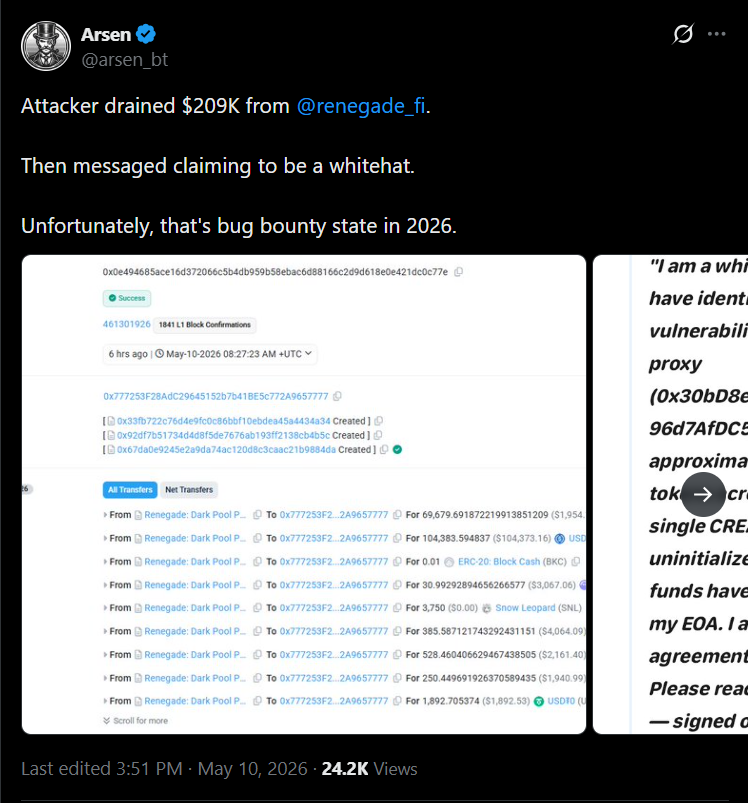
They claimed to be a Whitehat. They said they found a vulnerability, wanted 10% of the funds as a bounty, and were willing to negotiate. Renegade responded. The attacker complied and returned the funds minus the negotiated amount.
 The on-chain negotiation between the attacker and Renegade, ending with the attacker's message signed on-chain on Arbitrum One
A lot of people in the security community sympathized. Some openly supported it.
I understand why.
The bug bounty system is broken in ways that do not get talked about enough. Valid findings get marked out of scope. Real vulnerabilities get invalidated on technicalities. Researchers spend weeks building a proof of concept, write a detailed report, submit it through the proper channels, and get told the issue does not qualify. No appeal. No recourse. No explanation that holds up to scrutiny.
That frustration is legitimate. The system has failed Whitehats repeatedly and visibly. When someone sees a protocol dismiss a critical finding and then watches an attacker drain that same protocol six months later, the anger is not irrational.
But the Renegade situation is not a Whitehat story. It is an exploitation story with a negotiation attached.
A Whitehat does not take the funds first and ask questions later. The moment you drain a protocol without authorization, you have crossed a line that your intentions cannot uncross. The message left behind does not change what happened. It reframes it. And that reframing, however sympathetic it feels, is dangerous for everyone in this space who operates legitimately.
Trust is the only real currency a Whitehat has. Protocols engage with security researchers because they believe the researcher will disclose responsibly. The moment that assumption becomes conditional — "I will disclose unless I decide the bounty system is unfair" — the entire foundation of responsible disclosure starts to erode. And it erodes for every researcher, not just the one who made that call.
The system being broken does not make this right. It makes it understandable. Those are not the same thing.
What Actually Needs to Change
Every major bug bounty platform needs a mediation layer with teeth.
Some platforms have attempted this. Immunefi has a mediation process. But facilitated negotiation is not the same as enforceable determination. If a protocol walks away after mediation, the researcher still has no recourse. The finding disappears. The protocol moves on.
What is actually needed is a neutral technical body that can review the submission, assess the proof of concept, and issue a determination that both sides are bound by before the engagement begins. Not a forum post. Not a Twitter argument. A structured process with people who can actually read the code and call it what it is.
Active monitoring needs to be part of that too. One of the quieter bad-faith patterns in this space is a protocol receiving a report, marking it invalid or out of scope, and then quietly pushing a fix to the codebase weeks later. That should be detectable and it should have consequences. Platforms that want researcher trust need to build systems that make silent fixes visible.
And further upstream, more protocols need to stress-test before they deploy. Cyfrin's Battlechain exists for exactly this reason. A dedicated testnet where adversarial conditions can be simulated before mainnet, before real funds are at risk, before a researcher has to choose between responsible disclosure and watching a preventable exploit happen. If more protocols treated pre-deployment security as seriously as post-deployment audits, fewer critical bugs would make it to production in the first place.
The Whitehat community cannot fix the system by becoming the threat. That path ends with protocols treating every security researcher as a potential attacker, which makes everyone less safe.
The fix has to come from building better infrastructure around disclosure, mediation, and prevention. That is slower. It is less satisfying than a dramatic drain and a negotiation message.
But it is the only version of this that actually works.